Wednesday, 27 October 2010

Larry Page’s Google Business Card c.1998

Larry Page’s Google Business Card c.1998: "


Q. What’s the most expensive mistake you’ve made at work?


A. I met both Carl Page and Larry Page at a party hosted by a Stanford friend of mine in 1998. Carl gave me his card for eGroups and said “we’re hiring”. Larry gave me his card for Google—a flimsy bit of paper obviously printed by bubble jet—and said “we’re hiring”. I said, “Nah, who needs another search engine?” and went to graduate school. I still have the card. (Zestyping)


"

Monday, 25 October 2010

Sniff Out User Credentials at Wi-Fi Hotspots with Firesheep [Downloads]

Sniff Out User Credentials at Wi-Fi Hotspots with Firesheep [Downloads]: "
Firefox: Firesheep sniffs out and steals cookies—and the account and identity of the owner in the process—of popular web sites from the browsing sessions of other users on the Wi-Fi hot spot you're attached to. More »


"

“Time-traveler” in 1928 Chaplin Film

“Time-traveler” in 1928 Chaplin Film: "


“This short film is about a piece of footage I (George Clarke) found behind the scenes in Charlie Chaplin’s film “The Circus”. Attending the premiere at Mann’s Chinese Theatre in Hollywood, CA – the scene shows a large woman dressed in black with a hat hiding most of her face, with what can only be described as a mobile phone device – talking as she walks alone.


I have studied this film for over a year now – showing it to over 100 people and at a film festival, yet no-one can give any explanation as to what she is doing.


My only theory – as well as many others – is simple… a time traveler on a mobile phone. See for yourself and feel free to leave a comment on your own explanation or thoughts about it.


George – 20th October 2010″


"

Sunday, 24 October 2010

The Difference Between Twitter and Facebook

The Difference Between Twitter and Facebook: "Twitter-vs-Facebook1

What is the difference between Twitter and Facebook? Leave it to Kiersten Essenpreis and @shaylamaddox to help you figure that out. It really sums up the common themes I hear from people describing both services. Kiersten has some other great work aside from this illustration so I pulled some for your perusal here.


(more…)


Jay B Sauceda for PUBLIC SCHOOL, 2010. |
Permalink |
No comment |

"

2001 monolith "action" figure

2001 monolith "action" figure: "

340x_monolith_action_figure_main_zoom.jpg


OK, sorry to meander off-topic, here, but when I saw this my L was actually OL, and I just had to share. This rectangular block of black plastic is the latest brainstorm from the clever marketeers over at ThinkGeek. ('Helps your other action figures evolve.') [via Gizmodo]


More:


Read the Full Story » | More on MAKE » | Comments » |


Read more articles in Toys and Games |


Digg this!"

Wednesday, 20 October 2010

A Wise Man Once Said – part 2

A Wise Man Once Said – part 2: "

a_wise_man_once_said_2


Stumble this!


"

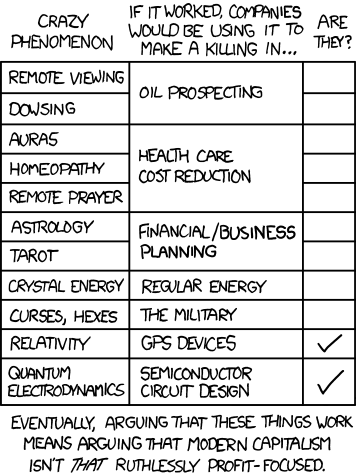
The Economic Argument

The Economic Argument: "Not to be confused with 'making money selling this stuff to OTHER people who think it works', which corporate accountants and actuaries have zero problems with."

Android and Tweetdeck Fathers Reply to Steve Jobs Putdowns

Android and Tweetdeck Fathers Reply to Steve Jobs Putdowns: "

As you may have some knowledge of if you were listening to the Apple earnings call yesterday, Steve Jobs himself let himself be heard on more than one subject, with some choice words for brands such as Android and Tweetdeck. Now there’s a bit of reply on the part of Andy Rubin (father of Android), and Iain Dodsworth (CEO of TweetDeck) through their Twitter accounts. Both of them aren’t exactly pleased with situation, but both seem to have kept their witty humor intact for the jab back.


During the talk yesterday, Jobs stated such things as TweetDeck having to “contend with more than a hundred different versions of Android” and that it was “a daunting challenge.” To which Dodsworth, as you can see, simply says, “Did we at any point say it was a nightmare developing on Android? Errr nope, no we didn’t. It wasn’t” Maybe the lines got crossed somewhere in that exchange.


Then there’s Rubin, who had to reply to Jobs comment: “We are very committed to the integrated approach, no matter how many times Google characterizes it as closed, and we believe that it will triumph over the fragmented approach, no matter how any times Google characterizes it as open.” Rubin replies in a much more subtle way: with a line of code, in his own way, explaining what “open” means. The code, in fact, when entered into Terminal, does thus: creates a folder named “android”, changes to that folder, initializes the “repo” program with the Android source host, downloads the source, and compiles Android. Like, open, man, open.


)"

Tuesday, 19 October 2010

The lost art of video game cartography

The lost art of video game cartography: "

We don't make maps of games anymore. Is that bad thing?

If you've been playing games since the ZX Spectrum era you'll remember there was once an essential piece of gaming kit that didn't need to be plugged into the back of your machine. It was a pad of blank paper. In the early days of interactive entertainment, making your own maps was a vital tool for progression. With the classic text-based adventures – from Will Crowther's Colossal Cave, through the Zork series and Scott Adams' cryptic quests – it was the only way players could visualise the experience amid the onslaught of verb-noun inputs and endless compass references.

Later, with the dawn of the graphical action adventure, the homemade map remained an important navigational device. Fans of Ultimate's classic isometric quests, Knight Lore, Alien 8 and Sabre Wulf, would pride themselves on their elaborate cartographic creations (at least in my school), while attempting to accurately chart Mike Singleton's epic Lords of Midnight, with its 4000 unique locations, was the eighties equivalent of Waldseemüller's Universalis Cosmographia. Keen gamer/mappers would compare techniques and send their works into the tips sections at magazines like ZZap 64 and Crash. Some favoured naturalistic approximations of the game environments, creating miniaturised ordinance survey maps. Others, like myself, used graph paper and went for a more diagrammatic approach, inspired by the topographic purity of Harry Beck's tube map.

But in the late-eighties, game design changed. The big home consoles from Nintendo and Sega brought an endless stream of slick arcade conversions – no one needed to map Altered Beast or R-Type. And while early Japanese RPG titles like Final Fantasy and Legend of Zelda initially required some mapping skills thanks to their burgeoning use of open world 'overmap' environments, later iterations brought in a variety of navigational aids. Breath of Fire II, for example, introduced world maps that opened up new sections as the player gained fresh abilities, effectively allowing the micro-management of exploration and lessening the chances of getting lost (a theme that would later expand into the whole hub world concept, championed by Super Mario 64). Then there were teleportation zones, and the ability to set waypoints across a map screen – somewhere along the line, travel became an inconvenience rather than the point of the game.

Elsewhere, CD-Rom technology allowed the birth of the cinematic adventure, complete with FMV and CGI story sequences. This heavily story-based form of design required a linear structure, with choke points and bottle necks to host key plot changes. That's pretty much where we are with big action adventure titles like Tomb Raider, Uncharted, Batman: Arkham Asylum and Call of Duty. The whole concept of exploration has changed; we no longer need to explore to progress, we explore to find power-ups and hidden extras, and in this overtly stage-managed form of freedom, cartography isn't really necessary. The pictorial map has been replaced by the didactic walkthrough.

Even so-called 'open world' titles are map-free experiences. There will usually be a mini-map or radar display in the corner as well as an HUD that paints your required destination with big arrows and a distance read-out. In games like Doom and Resident Evil, which require endless revisitation of old map sections, exploration becomes a sort of neurotic dance, an insect triangulation, in which the route maps are burned on the memory like rhythm-action button presses.

Do we really, truly explore game worlds anymore? Can we? I think in some ways, this goes deeper than mere changes in game design. It's interesting that GPS technology has evolved into a mass mainstream phenomenon at the same time as games; both are now about ridding us of the need to understand and read our environments. There have been a few titles that have attempted to engage us in map-making again – the DS RPG Etrian Odyssey requires you to draw your own map on the touch screen, while Legend of Zelda: Phantom Hourglass lets your customise and add notes to the pre-designed map display. But these are rare novelties.

I miss game maps. There was something fundamentally immersive about creating your own interpretation of the virtual environment, of relying on your own systems and diagrams to get you through. I could be wrong of course, there may be dozens of titles I've missed that positively invite cartographic interaction – if so let us know in the comments section. I suspect not. We are, as a race, moving toward a guided, systematic form of orientation in which anything worth seeing has already been geo-tagged, reviewed and Google mapped. Getting lost in a game, or in a city, is now a completely unnecessary annoyance. It was once a means of discovering amazing things.


guardian.co.uk © Guardian News & Media Limited 2010 | Use of this content is subject to our Terms & Conditions | More Feeds

"

What If Google’s Social Layer Is Chrome? What If Facebook Builds A Browser?

What If Google’s Social Layer Is Chrome? What If Facebook Builds A Browser?: "


Since being wrestled back from Microsoft’s death grip, the web browser has thrived thanks to its openness. All of the popular browsers beyond IE — Firefox, Chrome, Safari, Opera — are either based on open-source or have a thriving community that helps develop and expand each of them. And it’s relatively easy for a user to switch between any of them. But what if that were to change?


I have no direct knowledge that this is about to happen, but recent conversations have had me thinking about this. What if say, Google, in their attempt to finally create a cohesive social experience, decided to forgo building yet another service and instead went for the ultimate layer: the browser?


They could do this, of course, because they make the Chrome web browser. Just imagine a web experience where you signed in once and that was it. For the rest of the time you used that browser, everything would be set for you. Notifications, instant messages, status updates — those would all come in and go out through Chrome, not some website you have open within Chrome.


That may sound weird, but we’re not that far away from this personalization of the browser. Consider that Chrome’s Omnibox (the URL bar and search box) is already a Google zone. Sure, you can set it to use another search engine, but how many people do you think actually do that? And now that Google Instant is being integrated into it, it seems like the connection will only get stronger.


And shortly, Chrome will have its own Web App Store. These apps (some of which will be paid) will only run in Chrome itself. And the payment mechanism and DRM will have to be run through the browser.


How will that work? Presumably, you’ll have to be signed in to your Google account when using the browser. Google has already put some of this in place by enticing people to put their credentials in to the browser for things like bookmark sync. And the latest builds of Chromium make it very clear that you’re signed into the browser, not some website.


Oh yeah, and there’s this thing called Chrome OS which is due to launch shortly. How do you think that will work? Yep, you’ll be logged in to your Google account the entire time. From what I’ve heard, the basic high-level thought is that Chrome OS and Chrome are the same thing. One is simply going to be an operating system within another operating system (Windows, OS X, or Linux), while the other won’t have that additional layer. But functionality-wise, they’ll be the same.


Other attempts have been made at social web browsers — notably, Flock. But Chrome has been smart to slowly integrate personalizations over time. And they have two killer features: Google services and the fastest browser. Now that Chrome is approaching 100 million users, it may be getting close to the time that Google could strike with a fully social browsing experience.


Undoubtedly such a move would garner backlash, but Google could point people in the direction of Chromium, the open-source browser on which Chrome is based. The truth is that right now, Chromium is little more than a testing ground for Chrome. But what if it truly became the open-source alternative to the Google proprietary browser? Again, none of this sounds that far-fetched to me.


We want people to be more logged in to Google,” CEO Eric Schmidt said last week. Having an always-on presence at the browser level could certainly achieve that. Google would be able to see everything you do on the web. And they would be smart enough to make you opt-in to this. All in the name of serving you better content, I’m sure.


To see an even more extreme version of this model in action, you only have to look at Android and the iPhone. With each of those platforms, you sign-in not at the browser level, but at the system level. Again, this is all done in the name of ease (which is very real), but it also gives both Google and Apple access to a huge amount of data about you.


And if you think the web isn’t going to move that way, you’re dreaming. Even if it isn’t Google that pulls off the ultimate Chrome web browser, rival Facebook just might.


They haven’t given any indication that they want to be in the actual browser space, but Google didn’t either before they dropped Chrome in our laps. And Facebook CEO Mark Zuckerberg has made a lot of comments recently suggesting that there needs to be a better way for users to sign-in once on some system and forget about it. Facebook Connect is sort of that. But it doesn’t go deep enough, and Zuckerberg knows it.


That’s why the notion of a Facebook Phone isn’t so crazy. It would require years of work, but just look at what Google and Apple are doing now. A Facebook browser would be a shorter-term solution to some of what Facebook undoubtedly wants to do.


You might laugh at the notion of a Facebook web browser, but be honest: how many of your friends would use it? Probably a lot. If it had chat, alerts, and, of course, the News Feed, it would be a huge hit. You could visit any site on the web, but you’d be already logged in to your Facebook account. And you’d have one-click access to all your Facebook credits to buy whatever you wanted.


And it would be huge for sharing.


The more I think about this, the more I think it would be crazy for Facebook not to do this. Because Google is going to. And Google and Apple already have a huge head start on this deep integration thanks to their mobile platforms. Facebook is in the middle of a race they haven’t even started running yet.


Again, I have no concrete evidence on any of this, but I have this feeling that web browsing as we know it is about to change. For us, such a shift would be both good and bad. But for the web powers that be, it would be all good.


"

Disney to Distribute The Avengers and Iron Man 3

Disney to Distribute The Avengers and Iron Man 3: "

Iron Man 3 scheduled for May 3, 2013

"

Monday, 18 October 2010

3D Lego printer

3D Lego printer: "


The MakerLegoBot is a Lego Mindstorms-based 3D printer that turns software descriptions of Lego builds into completed Lego pieces, automatically, picking and snapping down pieces as it goes. Next step would be a MakerLegoBot that prints other MakerLegoBots, of course:


A Java Application that runs on the PC takes an .ldr MLCad file, determines a set of print instructions, and then sends the instructions via USB over to the MakerLegoBot for printing...


The core concept that makes 3D print of Legos possible is the sticky grab and axle release mechanism. The printer head selects from an array of Lego bricks, moves to the correct location, and then places each Lego in its determined spot...


It took many nights and many iterations to get the feed system working consistently. The current design works with 1x2, 2x2, 3x2, 4x2, and 8x2 Lego bricks. Once a brick is grabbed, the next brick in line falls into place.


MakerLegoBot: A Lego Mindstorms NXT 3D Lego Printer

(via Makerbot blog)


"

Backstage Star Wars Photos

Backstage Star Wars Photos: "

These photos from the backstage of Star Wars absolutely blow my mind. Thanks for the tip Mr Hicks.


Photo of Darth Vader shouting at Luke showing bed mattresses below to protect them if they fall


Modlers moving the At-At walkers on Hoth


"