Tuesday, 9 August 2011

Cory Doctorow: Android and iOS both fail, but Android fails better

Cory Doctorow: Android and iOS both fail, but Android fails better:

How well a system works is only half the picture: the other half is how badly it fails

My recent review of the Samsung Galaxy Tab 10.1 Android tablet stirred up a dreary and inevitable round of OS advocacy and such, with both Apple and Android lovers baying like wounded members of persecuted religious minorities, arguing about which OS is most worthy of our love and devotion.

For me, no love or devotion is due to an operating system or a gadget.

I'm enough of an old technology hand to know that any love we harbour for our gadgets is unrequited and generally tragic – not least because you are not destined to have a long-term love-affair with your gizmos, as they will be semi-obsolete in a year or two.

Don't get me wrong. I know that some devices, apps and systems can work well – that is, they can make it easier to do something that was hard, or possible to do something that was impossible. That's why we all use this stuff. But I think that how well a system works is only half the picture: the other half is how badly it fails.

Because technology fails all the time. Networked, general-purpose computing devices have so many different failure modes that they can hardly be counted. Your phone or tablet can have problems coping with something as abstract as bad Maximum Transmission Unit sizes in its network connection, or as concrete as being dropped and trodden on by your toddler.

A program that runs flawlessly one day can be derailed by another program, or an OS update, or a mysterious configuration problem – hence the old 'Rename your preferences folder and restart' diagnostic procedure.

The general state of technology is to be broken; which is not so different from other complex systems, like technology's users. You might have lost a pre-beach holiday stone thanks to diet and exercise, only to get a spot on your cheek, bad traffic on the way to the airport, a row with your spouse, and a jammed knuckle from your suitcase handle. Human beings who can soldier on and stay happy and functional in the face of adversity are said to be 'resilient,' which means that they fail well.

After all, it's no good being the world's happiest, best-adjusted, nicest person if you fall to pieces the minute you get a paper-cut. And that goes double for interpersonal systems: any couple can be happy when everything is going right, but no marriage can survive unless both of its participants are capable of soldiering on when things are going pear-shaped.

I don't use Android tablets and phones because I hate Apple; I most certainly don't use them because I love Google. And I don't prefer Android to iOS because it works better than Apple — in some aspects, it does, in some aspects it doesn't.

I use Android because I don't trust Google. Sure, I trust and like individual googlers, and admire many of the things the company has managed – but I don't for one moment think that Google's management is making its decisions in order to make me happy, fulfilled and free.

I think there are good days when Google's management might believe that helping me attain those ends will make it more money, but if it were to believe that making me miserable would enrich its shareholders without alienating too many of its key personnel and partners, my happiness would cease to matter in the slightest.

So why use Android? Because it requires less trust in Google than using iOS requires that you trust Apple. iOS has one official store, and it's illegal in most places to buy and install apps except through this store. If you and Apple differ about which apps you need, you have to break the law to get your iPhone or iPad to run the app that Apple rejected.

Jailbroken iOS devices have sometimes been targeted by Apple security updates that render them inoperable, and jailbreakers have a reputation for not keeping their devices up-to-date.

By contrast, Android allows you to run apps from any store you choose. Google still rejects plenty of apps submitted to its store, but if you don't like Google's choices, you can decide to make some of your own.

That's failing well.

More of the internal workings of iOS are secret than their equivalent workings in the Android world. Apple's operating system runs more DRM processes that are intended to allow code to run that treats you as an untrusted adversary and refuses to accept your commands. Not least, Apple has to run all those processes aimed at stopping you from choosing to use an app that Apple hasn't blessed (and collected its 30% commission on).

I prefer Android because it's relative openness means more people can and do inspect its workings to ensure it is doing what Google claims it is doing. I prefer Android because when Google decides to leave out a feature that users might want – such as tethering – the people making alternative OSes for the platform stick that feature in, and shame Google into adding it in subsequent versions.

My mobile phone can track where I go. It can record my voice and image, and the voices and images of those around me. It can leak email, voicemail, texts, and passwords. In the time since I've gotten a mobile phone, each passing year has meant that I rely on my phone for more things, and I don't expect that will change.

Android and iOS will both fail their users in the years to come. Not a lot, but often enough, and dramatically enough, that it's worth ensuring that those failures are as minimal as possible.

I'd like an official Android version without the DRM, with complete source code, and with generally greater transparency into the device and its ecosystem. I like the alternative Android OS, CyanogenMod, because it has many of those things. Functionally, a CyanogenMod Android phone and a stock Android phone work in much the same way, but CyanogenMod phones fail better.

Our relationship to technology is this: We've jammed ourselves into the cockpits of supersonic jets that are being constantly redesigned as they hurtle around the planet, in dangerously close proximity to everyone else's supersonic jet. It's good to pay attention to how fast our jets go, and how comfortable the upholstery is, but the thing we really need to keep our eyes on is what happens when they crack up, when their navigation systems go awry, and when they get a bad upgrade.

When you're moving that fast, with that much at stake, failure is much more important than success.

guardian.co.uk © Guardian News & Media Limited 2011 | Use of this content is subject to our Terms & Conditions

Monday, 8 August 2011

Is G+ Putting Facebook On The Defensive?

Is G+ Putting Facebook On The Defensive?: Tom Anderson

Editor’s note: This guest post is written by Tom Anderson, the former President, founder and first friend on MySpace. You can now find Tom on Facebook, Twitter, and Google+.


If it’s not obvious yet, Google+ is going to be able to “undercut” Facebook when it comes to game developers and platform transactions. Instead of taking a 30% cut of all Farmville seeds (or whatever people are buying), Google will be able to take a smaller percentage for themselves. They may even take nothing. And when it comes to “monetization” on the G+ “website,” Google’s trump card against Facebook is that we may never even see an ad on G+. Google has plenty to gain without ever showing an ad and, put simply, Google doesn’t need the money. Facebook’s got to know this, and it’s got to have them just a little bit concerned.


This week, the WSJ reported that FB is testing out a “real-time” feed (as opposed to Facebook’s current default “Top News” algorithm). Presumably this new feed would become the new norm for users. Though I’d like to think Facebook has been listening to me when I critique their Top News algorithm, what’s really moving Facebook’s hand here (according to the WSJ) are complaints by advertisers and app developers. It seems that the “Top News” stream is killing the virality of advertisers “content” and of apps that are trying to find new users.


If it’s true that FB is considering these changes because of complaining developers and advertisers, that’s a real bad sign for FB. Facebook has made some defensive moves since the launch of G+, which in itself is unusual for them. But this is the first indication they may kowtow to complaining third parties. (Hey, the IPO is coming… competition is heating up, it has to happen, right?) Making decisions informed by the concerns of these third-parties doesn’t automatically spell doom, of course. But Facebook has been so darn good for so long because of their refusal to IPO, their refusal to think about the short term, and their refusal to let one party’s needs overshadow the general health of the service. The tough thing for Facebook is that the larger you get, and the more competing interests you have to consider, the more difficult your choices become.


FB’s trouble may seem like a positive for G+, but it’s not that simple. It’s a virtual certainty that Google will launch a platform (and not just a games platform), but how they do this is critical. We don’t want a repeat of Facebook’s cycle—where FB promised the world to developers, gave them free reign to build the hype, then cut off their marketing channels and destroyed their businesses (an oversimplification yes, but read this harrowing tale from Paul Allen)—so G+ needs to carefully balance the needs of developers with the health of the overall community.


From what I can tell, the heads at G+ are aware of the delicate balance that’s needed here. Though they gaffed in the way they carried it out, Google’s decision to block business accounts indicates that Google understands they need a real plan here. Frankly, I’m surprised that no “regular users” have spoken up to say they don’t want brands on G+. Maybe that’s just because 80% of the active users on G+ work in the “Internet industry” (at least according to my unscientific poll), and thus have something to gain by letting “businesses” into the service . Would “regular users” be so happy about this? As Matt Hogan argues, it may not be the best idea to let businesses come in and muck up the place at the very beginning.


That said, what we may be seeing here is a general evolution of brand-user interaction to the point that users trust that it just can “work” (like Twitter, where you can follow brands, but they can’t really bug you).


Because of poor planning on my part, the regular-user / business relationship on MySpace was never quite right. Businesses wanted to be able to go around and add people on MySpace, and it was hard to tell them “no” because of they way MySpace evolved over time. Facebook was smart to make it impossible for “Pages” to add people & comment for the first few years. But they recently reversed that decision. Whether that turns out to be a good thing remains to be seen. (It’s an easier move to make for Facebook now when the “true” user base is already established, and Facebook has years of refining spam prevention algorithms under their belt.)


But whatever the case, both Google and Facebook have some tough decisions ahead of them: how do they balance what’s best for the regular guy (you & me), advertisers (big brands), small local businesses (who can never afford the big spend), platform developers with non-competing services (games & music, which it appears FB won’t get into) and platform developers with potentially competitive services (like business networking and dating, which FB/G+ may want to get into themselves someday).


Over the long haul (5-10 years), the company that makes the right choices in these areas may just end up winning.

Thursday, 4 August 2011

A Guide to Google+ Privacy and Information Control [Google+]

A Guide to Google+ Privacy and Information Control [Google+]: "
Google+ is the new social networking kid on the block, and one of the main reasons so many people are interested in the service over Facebook is Google+'s proclaimed focus on protecting users' privacy. Whether you're a new Google+ user or you're already a pro, understanding how to control your information on the site can make you feel much more at ease on the social network. Here's the lowdown on Google+'s privacy controls, including a few of the more buried settings you'll want to know about. More »


"

Warner Bros. Reveal Our First Look At Henry Cavill In Full Costume As Superman!

Warner Bros. Reveal Our First Look At Henry Cavill In Full Costume As Superman!: "STARRING:

Henry Cavill as Clark Kent/Superman
Amy Adams as Lois Lane
Kevin Costner as Jonathan Kent
Diane Lane as Martha Kent
Michael Shannon as Zod

RELEASE DATE: June 14th, 2013."

Thursday, 28 July 2011

Catch the London Underground with Google Maps

Catch the London Underground with Google Maps: "(Cross-posted from the Official Google Blog)

Starting today, you can get public transport directions for London within Google Maps. One of Europe’s largest metropolitan areas, London is a major destination for both business travelers and tourists. More than 1 billion passengers are serviced by Transport for London (TfL) every year across over 18,000 bus stops and over 250 Underground stations.

Let’s say you’re at Trafalgar Square, and you want to visit Madame Tussauds. With a simple directions search, you’ll see all the possible public transport connections. In Maps, click “Get directions” in the left-hand panel, and then the train icon to see public transport directions. Enter your departure location next to A, and your destination next to B. These can be either street addresses or names of popular places, businesses or restaurants. When you’re done, click the “Get directions” button and suggestions for your trip will appear below.


Public transport directions are available on both Google Maps and Google Maps for mobile, so you always have access to a trip planner. When you’re on mobile, Maps even uses your current location to determine the best trip to your destination. Just search for your destination location, select it on the map and choose the “Directions” option. The suggested trips will be based on your location by default, and provide you multiple alternatives whenever possible.

If you’re using an Android-powered device, you can also get public transport directions with Transit Navigation (Beta) in Google Maps. With this new feature, which we launched earlier this month, you’ll get alerts when it’s time to get off the bus or train at your destination or to make a transfer. Transit Navigation is available in all regions where public transport directions are available, including London.


TfL is among the first agencies in a major European city to make its timetable information publicly available through the London Datastore. We’re strong supporters of open data and bringing information out into the open, and believe that making information publicly accessible can be an enormous engine of economic growth and innovation. ITO World has been a great partner in this launch by ensuring TfL’s data was adapted correctly and ready for our use.

Public transport directions are available for all Underground, bus, tram and Docklands Light Railway (DLR) lines, and we’ll include more public transport information as soon as it’s available. Whether you use public transport every day or infrequently, as a commuter, on a business trip or as a tourist, we hope that public transport directions in London make planning your trips more convenient!

Posted by Thijs van As, Associate Product Manager, Transit Directions


"

Wednesday, 27 July 2011

Oracle Deletes Blog Post Showing CEO’s Approval of Java in Android

Oracle Deletes Blog Post Showing CEO’s Approval of Java in Android: "

While I’m not going to jump into this story too deep I’ll start with linking to our Oracle Portal. You will find all the stories and background you need. Basically Oracle is suing Google for the use of Java code in the Android OS. We reported on this a while back and little bits and pieces have slowly appeared over the past few months.


While Oracle is claiming Google directly copied Java code for use in Android, others have said that story isn’t accurate. I’m sure there is plenty that the general public and even those working for both companies don’t know. It boils down to Oracle wanted a few billion dollars in return from Google for stealing code and infringing on patents.


Before these lawsuits even appeared this was already being debated so this wasn’t anything new or a surprise to Google. Back to the lawsuit, Even the judge thought the initial request for 2.6 billion in compensation for the patent infringements was a little extreme and suggested Oracle and their team of lawyers go back to the drawing boards for a more accurate claim.


Latest news that I’m just hearing looks to not only make Oracle look bad, but like they have something to hide and I’m sure the judge wont like how things appear. When Google first launched Android it seems Oracle and Sun were completely for it. Sun’s CEO posted a comment on their blog in 2007 stating how excited and pleased they were to see Google using the Java/Linux code and even added Google to the list of supporters. Here is the “deleted blog post”


I just wanted to add my voice to the chorus of others from Sun in offering my heartfelt congratulations to Google on the announcement of their new Java/Linux phone platform, Android. Congratulations!

I’d also like Sun to be the first platform software company to commit to a complete developer environment around the platform, as we throw Sun’s NetBeans developer platform for mobile devices behind the effort. We’ve obviously done a ton of work to support developers on all Java based platforms, and were pleased to add Google’s Android to the list.


And needless to say, Google and the Open Handset Alliance just strapped another set of rockets to the community’s momentum – and to the vision defining opportunity across our (and other) planets.


Today is an incredible day for the open source community, and a massive endorsement of two of the industry’s most prolific free software communities, Java and Linux.


If Oracle and Sun endorsed Android way back when it first launched and fully were aware of what Google was using this could cause a huge problem for their case. And now they go out and delete the blog post like they’ve got something to hide could make things even worse. I’ve not followed this entire case but I’ve read enough to clearly see things aren’t completely lining up and they are now simply trying to snag some of the Android cash flow.


[via Phandroid]


)

"

UK Storm Trooper armourer can go on selling his gear; Brit copyright on Star Wars costumes has lapsed

UK Storm Trooper armourer can go on selling his gear; Brit copyright on Star Wars costumes has lapsed: "

Andrew Ainsworth is a Londoner who designed the original Storm Trooper helmets for George Lucas’s Star Wars. Ainsworth has been casting new armour from his original moulds for the past eight years, selling them to fans at up to £1,800 a throw. Lucas sued Ainsworth in a US court, which held that he had violated Lucas’s copyright; but because Ainsworth has no US assets, Lucas had to bring suit in the UK to collect. However, UK law affords only limited copyright to costumes, and the UK Supreme Court held that costumes are not sculptures, and only get a 15 year term of copyright in the UK, meaning that Storm Trooper armour is now in the public domain in Britain. The court also found that Ainsworth had violated US copyright.


Mr Ainsworth sells his Stormtrooper costumes for up to £1,800


A prop designer who made the original Stormtrooper helmets for Star Wars has won his battle with director George Lucas over his right to sell replicas.


Andrew Ainsworth, 62, of south London, successfully argued the costumes were functional not artistic works, and so not subject to full copyright laws.


George Lucas loses Stormtrooper battle at Supreme Court

(Thanks, @erichhugo!)


"

Tuesday, 19 July 2011

Google+ Now Available for iPhone [Downloads]

Google+ Now Available for iPhone [Downloads]: "
Google+ is now available on your iPhone so you can use the social network natively on your device. It provides access to your circles, stream, profile, and more. You can upload photos, check your stream, interact with others, and do much of what you'd expect to do with Google+ on your iPhone. Notably missing is the hang outs feature, so no video conferencing via your iDevice just yet. Hopefully that's something Google can add soon. More »


Building outlines now appearing in London, Paris, Barcelona, and more

Building outlines now appearing in London, Paris, Barcelona, and more:
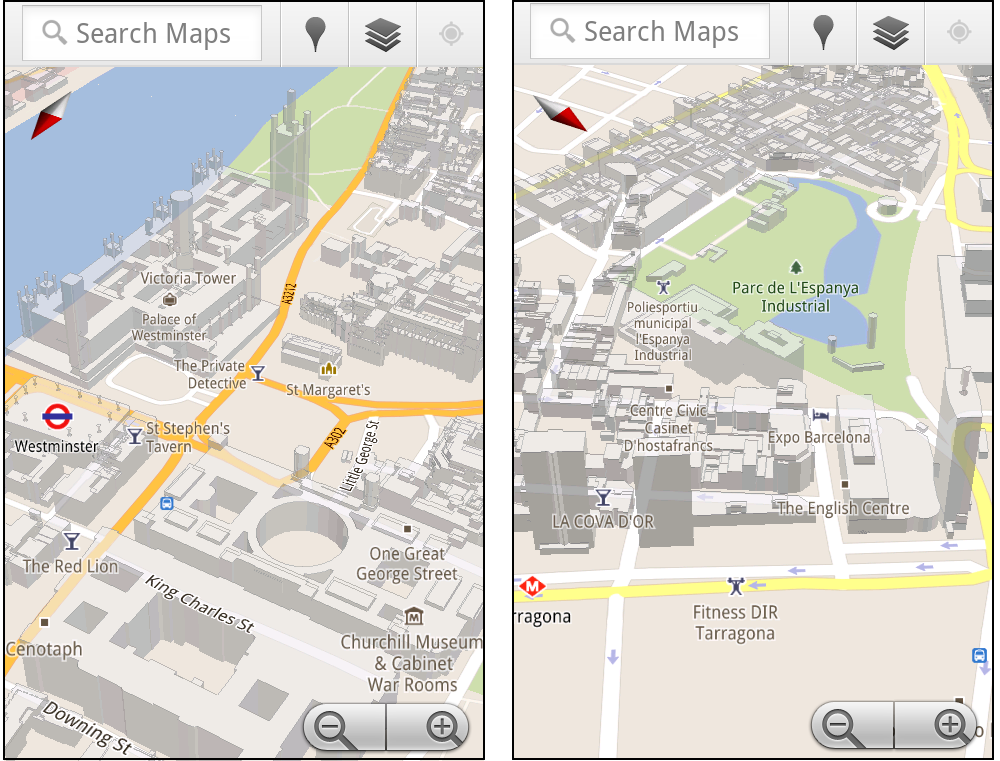
Since early 2007, Google Maps has made maps more lifelike by showing 3D building outlines when zoomed into cities. If you’re planning to walk down a street, you should know whether to expect low buildings, skyscrapers, or some cool architecture! Then the release of Google Maps 5.0 for Android ushered in the next-generation of mobile maps where you can rotate, tilt, and zoom in and out of 3D maps on a mobile device.

Now, 3D buildings are available in London, Paris, Barcelona, Stockholm, Singapore, Lisbon, Boulder, and 11 major cities in South Africa. These buildings will appear in both Google Maps and Google Maps for mobile.


View Larger Map
Ellis Park Stadium in Johannesburg, South Africa

3D buildings in London and Barcelona

Enjoy the new buildings from Boulder to Bloemfontein!

Posted by Mark Limber, Group Product Manager

Google+ vs Facebook [comic]

Google+ vs Facebook [comic]: "


Via the talented Beatriz Torres aka Zirta.


All the top social media happenings.


Permalink

| Leave a comment »

"

Breaking news! Catch up EPG now links to BBC iPlayer content from today for Virgin Media's TiVo

Breaking news! Catch up EPG now links to BBC iPlayer content from today for Virgin Media's TiVo: "

As reported at Cable Forum. More details to follow

"

Sunday, 17 July 2011

The Internet of Things [Infographic]

The Internet of Things [Infographic]: "

In 2008, the number of devices that connected to the Internet exceeded the number of people. That number continues to rise, thanks to a growing number of connected devices and gizmos, ranging from televisions to soda machines. Folks at Cisco have put together this infographic to showcase the growth of the Internet of things.


.


Infographic courtesy of Cisco.


Related research and analysis from GigaOM Pro:
Subscriber content. Sign up for a free trial.

"

Saturday, 16 July 2011

New Pic Of Karl Urban As Judge Dredd

New Pic Of Karl Urban As Judge Dredd: "This looks to be an official still, which doesn't make to much sense considering the last one we received looked like THIS. Why shade in the detail if we have seen the full helmet/costume already? Anyway, nice to have another pic, things have been fairly quiet on the Dredd front lately.

Here is a (probable) detailed plot synopsis. Mild spoiler warning..

In a future where Earth has become a radioactive wasteland, 98% of the Human Population is concentrated in the Mega-Cities, where the law is enforced by the Judges, a police force entitled to act as jury, judge and executioner. The best Judge there is is Dredd (Karl Urban), who operates in Mega-City 1.

One day, Dredd is assigned to train recruit Judge Anderson (Olivia Thirlby), who had previously failed the Judge Academy, but received a second chance for being a mutant with heightned psychic abilities that might be useful. The duo is deployed"

Friday, 15 July 2011

The Brutally Honest Guide to Naming Circles in Google Plus

The Brutally Honest Guide to Naming Circles in Google Plus: "

The Brutally Honest Guide to Naming Circles in Google Plus

This content from: Duct Tape Marketing

Users of Google+ are quickly coming to the conclusion that one of the game changing features offered up by this new social network is the following and sharing filter called Circles.

For those that have not yet wandered into G+, you can segment those you follow into groups (circles) with the idea that this gives you the ability to share selectively – business contacts get business stuff, family and friends get pictures of cats doing funny things, etc.

Google Plus Circle Naming

One of the things that is plain to see, even in just a week of exploring G+, the world of online users have learned a great deal more about how to use social networks than just 3 or so years ago when we all jumped into Twitter.

Instead of blindly building followings people seem to be using the Circles tool specifically as a way to meter the stream of information and perhaps focus on smaller numbers in an attempt to limit the eventual overwhelm and uselessness that comes with large unfocused followings.

In a way G+ is acting as a bit of a do over for the early business users of Facebook that now find it harder to keep business and personal separate. This is by no means a proclamation that Facebook is dead, I’m simply finding in the early stages of G+ that people are using G+ in a way that differs from some other networks. That too will likely evolve.

Because the act of creating circles and then determining who goes where is so central to G+ it presents an opportunity to address the thinking process that goes into how we analyze these circles. I for one think it illustrates one of the most profound changes in social network use.

Instead of simply categorizing the default sounding demographic type circles such as family, acquaintances and coworkers, I’m seeing a move towards circles that consist of a focus on content – or what you expect to hear and how you expect to interact with members of a circle being the guiding light.

While Google Plus suggests some generic names for your first circles you are free to create and name as many as you like (there may be a limit, but not aware of one).

The image in this post was my attempt (humorous or not) to illustrate how I believe people are really thinking about their circles. I first published this image on G+ and it was shared over 1000 times by users, so I think others are sensing this and feeling this and struggling with this as well.

If you’ll allow me to get a little geeky here, this to me is the exciting part of the world we live in today – not that we have this new, new thing to go on about, but that change, evolution and growth are all organic parts of the social web and what may seem valid or not today will surely change as more and more people come to grips with practical uses for each new member of the parade of tools.


"